Tampilkan postingan dengan label Chandos. Tampilkan semua postingan

Sabtu, 08 September 2018

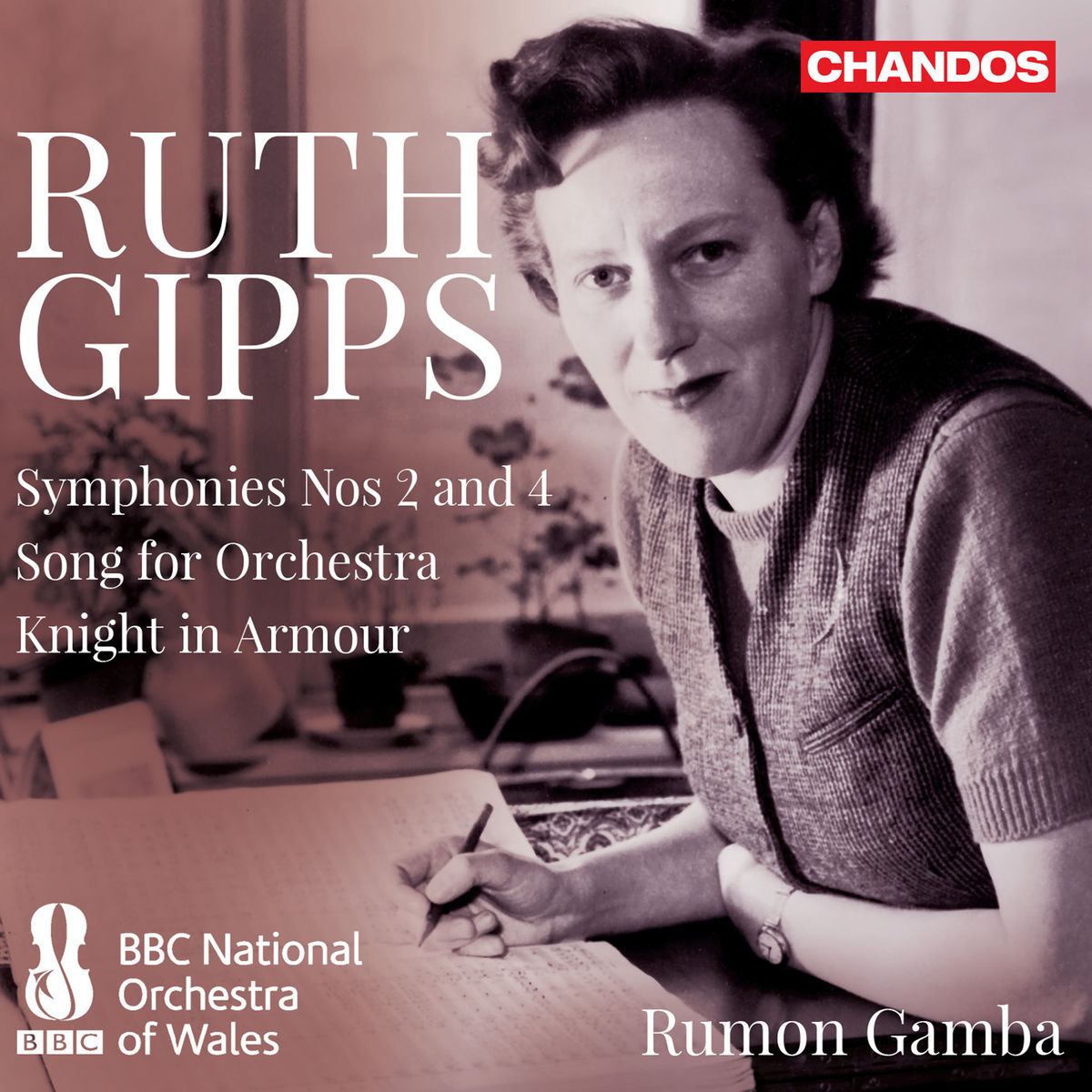
BBC National Orchestra of Wales / Rumon Gamba RUTH GIPPS Symphonies Nos. 2 and 4 - Song for Orchestra - Knight in Armour

The unjustly neglected and often dissident music of Ruth Gipps is with this album finding all the resonance it deserves by Rumon Gamba and the BBC National Orchestra of Wales, having already championed many British composers from the twentieth century with their series devoted to British Tone Poems and Overtures from the British Isles.
While, not surprisingly, there are echoes of the most popular composers of the time – Sibelius, Walton, and Vaughan Williams – the music is notable for its personal voice, confident conception, and vivid writing for the orchestra. Gipps herself actually felt her best works were those for orchestra.
In a programme of contrasting impressions and emotions, Symphonies Nos 2 and 4, the former inspired by the Second World War, offer an approachable tuneful idiom. They are complemented by the lyrical, shorter Song for Orchestra and the early tone poem Knight in Armour, premiered at the last Night of the Proms in 1942.

BBC Symphony Orchestra / Sir Andrew Davis FINZI Cello Concerto - Eclogue - New Year Music - Grand Fantasia and Toccata

A broad and meticulous selection of orchestral works and concertos by Gerald Finzi is here matched by a first-class cast of soloists, supported by the BBC Symphony Orchestra under the direction of Sir Andrew Davis, expert in British repertoire and conducting this year’s Last Night of the Proms.
Paul Watkins displays exhilarating virtuosity in the Cello Concerto, a central work on this album, composed in the wake of the devastating news that Finzi was terminally ill, but yet filled with ‘vigorous, almost turbulent thematic material’, as he wrote in the programme note for the work’s premiere at the Cheltenham Music Festival in 1955.
Louis Lortie, for his part, tackles the high-spirited and majestic Grand Fantasia and Toccata, the Fantasia originally conceived as part of a concerto for piano and strings and first performed on two pianos. This contrasts with the more restrained Eclogue for Piano and Strings, timeless, and blessed with a mood of benediction.
This album also features the orchestral Nocturne (subtitled ‘New Year Music’), dark, misty, and at times ironic.

“… it [Cello Concerto] ranks as one of the finest British works for cello and orchestra. When he [Finzi] started writing it in 1951, he already knew he did not have long to live, and the wistful land of lost content that never seems too far away in any of his music pervades this work. Watkins’ performance captures that mood perfectly. Nothing is exaggerated or over-assertive … Louis Lortie is the soloist in the ruminatively beautiful Eclogue for piano and strings, and is spiritedly athletic, with full orchestra, in the neo-baroque Grand Fantasia and Toccata. Andrew Davis and the BBC Symphony Orchestra make a fine job of the one near rarity in this collection, the strikingly atmospheric Nocturne …” (Andrew Clements / The Guardian)

Louis Lortie / BBC Philharmonic / Edward Gardner SAINT-SAËNS Piano Concertos Nos. 1, 2 and 4

Having already mastered such French concertos as Poulenc’s on record, the French-Canadian pianist Louis Lortie and Edward Gardner now explore with the BBC Philharmonic the vigorous and progressive world of Camille Saint-Saëns, offering the first of two volumes to contain his complete piano concertos.
The brilliance, virtuosity, and technical perfection of Louis Lortie’s playing encapsulate these unusual, yet exhilarating works. While the spirited, unconventional Concerto No. 1 centres round a slow movement consisting of a dialogue between the sober orchestra and virtuosic piano, the technical requirements of No. 2 are so high that Saint-Saëns himself after its premiere admitted that his fluent technique was not quite up to the challenge. Finally, the unusual form and mixed musical ideas of No. 4 make for a uniquely dramatic, passionate, and dream-like experience.

Doric String Quartet MENDELSSOHN String Quartets Vol. One

Alongside its ongoing and much lauded Haydn and Schubert series, both on-stage and on-record, the Doric String Quartet with this Mendelssohn album is adding a new milestone in its repertoire.
Mendelssohn wrote and published these three quartets at very different stages in his life and they therefore outline the complete trajectory of his creative output.
The early Op. 12, also called No. 1, was composed in London and includes many musical allusions to Beethoven, dead only a few years before its composition. These subtly contrast with Mendelssohn’s genially flowing energy.
While Op. 44 No. 3, which incorporates many deft variations, developments, and combinations, follows an extended honeymoon tour and Mendelssohn’s twenty-ninth birthday, Op. 80 emerged from a bout of helpless depression after the sudden death of Mendelssohn’s older sister and confidante, Fanny. Mendelssohn described this quartet as a Requiem, and the nervous agitation often found in his music here bursts forth with full force. Resignation, agitation, and nostalgia shape the work, the almost shocking finality of which may be said to prefigure Mendelssohn’s own death only six months later.

Selasa, 21 Agustus 2018

Alexander Ivashkin / Russian State Symphony Orchestra / Valeri Polyansky GIYA KANCHELI Simi - Mourned by the Wind

Distrustful of virtuosity for its own sake, and aware of his own technical limitations, Giya Kancheli has deliberately avoided using the term "concerto" for his works for cello and orchestra, Simi and Mourned by the Wind. It may be said, however, that these pieces are concerto-like, insofar as sustaining long pitches and controlling the instrument's tone are equally challenging to the performer, and both pieces display serene, chant-like phrases that require a light touch and a steady bow arm. Kancheli's expressions are decidedly somber and meditative -- note the words in the subtitles, "bleak reflections" and "Liturgy in memoriam" -- and it may become obvious why he chooses to score many passages in the cello's and orchestra's lowest range and seldom ventures into the brighter upper octaves, except for occasional eerie harmonics and fleeting "night music" sonorities. The cello's central role in Simi is reversed in Mourned by the Wind, where the orchestra is dominant and the cello reduced to a less active part; yet cellist Alexander Ivashkin is the musician listeners will follow, and his subdued but warm playing is always distinctly separated from the orchestral mass, even at its loudest. The Russian State Symphony Orchestra, conducted by Valery Polyansky, is fully engaged in these brooding performances, and Chandos' sound quality is evenly balanced.